
Before there were screens, there was sound.
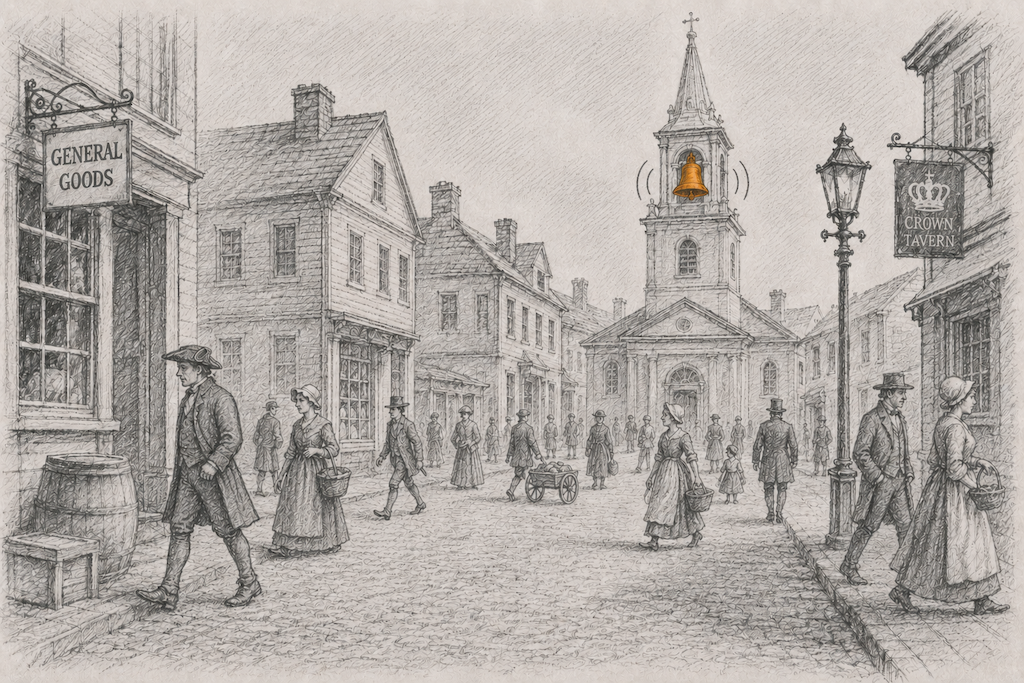
A bell in a tower could tell a whole town what time it was, that a fire had broken out, that someone had died, that it was safe to come back inside. Nobody had to look at the bell. The meaning traveled through the air and arrived to everyone at once. The information was in the sound.
Humans have always lived this way. We are built for it.
For most of our history, the things we most needed to know reached us through our ears. In ancient Israel, the shofar was sounded in set patterns where the rhythm of blasts was the message: gather, prepare, take heed. Across West Africa, drummers learned to reproduce the tones of speech so closely that a drum could carry a sentence across miles of forest, faster than a runner could. European villages hung a single bell that did many jobs at once. A slow, even toll marked a death. A frantic clanging, the tocsin, warned of fire or attack. A measured ring at dusk, the curfew, told everyone to bank the hearth fires for the night.
At sea, the ship's bell divided the day into watches so a sailor below deck always knew the hour. In cities across the early Islamic world, the call to prayer rose over the rooftops at fixed times, a single voice carrying a known meaning to everyone within earshot at once. None of this asked you to stop what you were doing and look at the source. You simply knew.
Then our information signals moved onto screens. And screens ask something of us that sound never did. They ask us to look.
Sight is an extraordinary sense, but it is a narrow and directed one. You have to aim it. Your sharpest vision covers only a few degrees at the center of your gaze, which is why we turn our heads, point our eyes, and lift a device up to our faces. To read a notification, you have to stop, orient, and decode text with the one sense that demands your full attention just to be used at all.
Hearing asks for none of that. It works in every direction at once. It reaches you with your eyes closed, your back turned, your attention somewhere else entirely. A parent asleep in a quiet house still wakes to the particular cry of their own child. We can recognize thousands of distinct sounds and pull meaning from each one in an instant, without looking at anything.
So here is the strange part. We carry devices that buzz at us dozens of times a day, and nearly every buzz sounds the same. The notification tells us only that something happened, not what. To learn the what, we do the thing billions of us do over and over: reach for the phone, look down, and read. We have taken the richest, most effortless information channel we own and flattened it into a handful of generic chimes.
Vybit puts the meaning back into the sound.
The idea is simple. You choose or record a distinct sound for each thing you care about, and from then on the sound itself tells you what happened. A rolling thunderclap when a storm moves into your area. A cash register for a sale. A particular voice saying the words you need to hear. One specific alarm, and only that one, for the cloud server you cannot afford to lose. When it plays, you already know, and your eyes never leave the road, the recipe, the conversation, or the work in front of you.
A sound does not have to be yours alone, either. Share one with your spouse so a soft chime means you are on your way home. Share one with your team so a single unmistakable alarm means latency just spiked on a critical cloud service. Share one with your customers so a signature sound announces that the thing they were waiting for has finally arrived.
That is where the name comes from. Each sound is a VIBE, and each VIBE is tied to one BIT of information. VIBE plus BIT: Vybit. The whole product is built on a fact about people that is far older than phones, which is that we read the world by ear remarkably well whenever sound is allowed to mean something.
The payoff is a kind of efficiency that sight cannot match, for the simple reason that sight has to be aimed and sound does not. A glance costs you your attention. A sound costs you nothing. You can be kept current all day long, told exactly what is happening around you and across your digital life, and never once break your focus to find out. The information is in the sound.
This matters more now than it ever has. We are moving into a world where software does more and more on our behalf, where assistants and agents carry out long tasks while we step away from the screen. The question stops being how to watch everything happen and becomes how to stay in the loop without standing guard over a progress bar. That is a question your ears were built to answer, and it is exactly where we are headed in the next post.
For now, the takeaway is primal. You do not have to look to know. You only have to listen.