
Last time, we ended on a promise about where all of this is going. Software is starting to do more and more on our behalf, not just reminding us to do things but actually doing them, working through long chains of steps while we get on with our lives. This future has arrived faster than most people expected, and it is changing how we interact with our work.
For years, the hard part of getting a computer to help was telling it exactly what to do, one click at a time. Now you can hand a capable assistant a goal in plain language and walk away while it plans, searches, compares, drafts, and acts across a dozen different services. The work still happens. You are just no longer the one doing each step.
Which leaves a new and oddly familiar problem. When something works away on your behalf for ten minutes or ten hours, how do you know how it is going? The obvious answer pulls you right back to the screen you just escaped. You watch a progress bar, refresh a chat window, keep a dashboard open in a tab and glance at it every few minutes, half present in whatever else you are trying to do. The agent freed your hands and quietly chained your eyes back to the glass.
People used to solve this without screens at all. Think of an old corner store. The proprietor could be in the back room, unpacking a crate, and still know exactly how the shop was doing, because the shop told them out loud. The bell over the door jingled when someone came in. The register rang and the drawer thunked when a sale closed. Paper crinkled and the scale's weights clinked while an order was wrapped. A regular's voice carried, familiar and easy. A busy shop sounded busy, a slow afternoon sounded like silence, and a raised voice meant come up front, now. None of it asked the keeper to look. The whole room was an information system, and nobody thought to call it one.
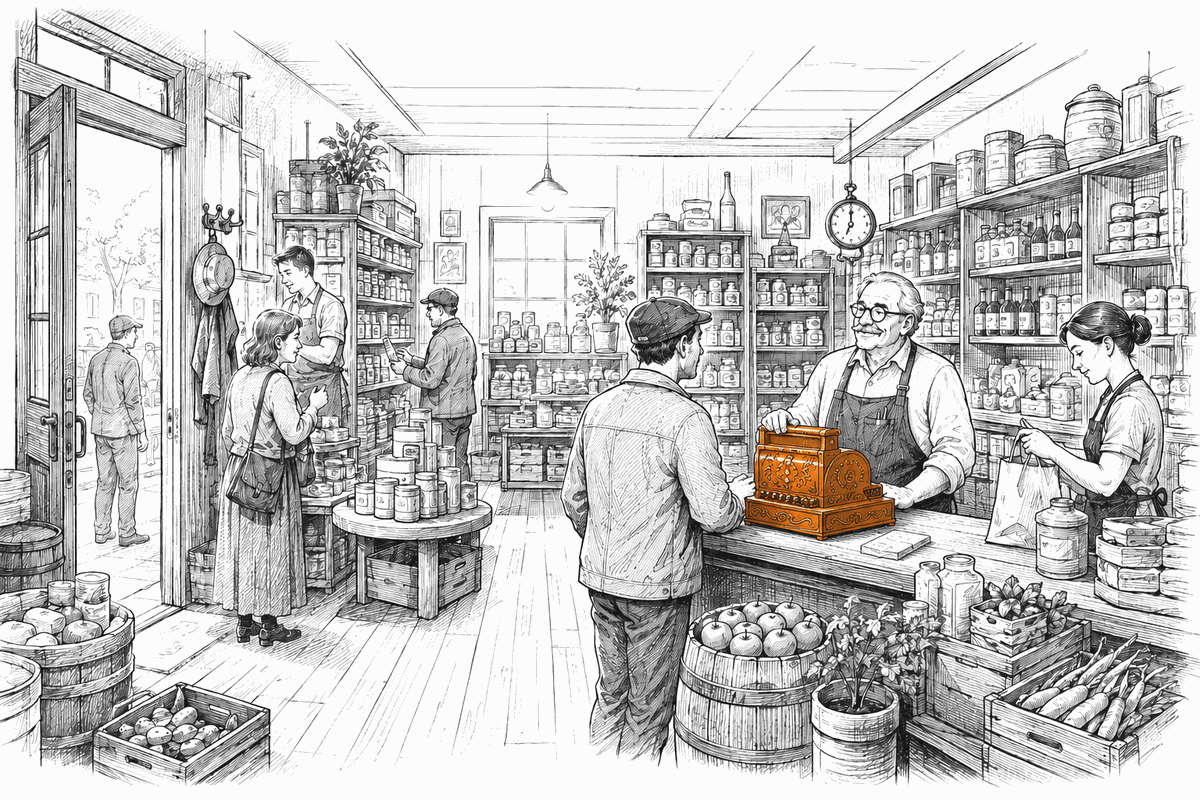
That register bell was not an accident, either. When James Ritty built the first cash register in 1879, he called it the Incorruptible Cashier, and the bell was the entire point. It rang on every sale so the owner could hear that money had reached the drawer without standing over the counter. If a customer paid and no bell sounded, something was wrong. The very first thing we automated about running a shop, we chose to report by ear.
Now move that shop into the present. It lives on a storefront and a payment processor, and more and more of it is minded by an agent that works the floor all day. Orders arrive, and it checks stock, prepares the shipping, and answers the routine where-is-my-package questions on its own. That is dozens of small steps an hour, and you cannot and should not watch them. So, with Vybit, you give the room its sounds again. The door jingle returns as the signal that a new visitor or a fresh lead just arrived. The register's ka-ching comes back for a sale, and because a sound can carry more than the bare fact, a bigger sale rings a grander bell, so you hear not only that you sold something but roughly how much. Orders moving through fulfillment get their own quiet, satisfying markers. And one sound, sharp and reserved for a single meaning, is the raised voice from the front: a customer is upset, and the agent has decided this one needs a human. Silence still means a lull.
Those few sounds carry most of what anyone running anything ever needs to know: that something happened, which thing it was, how big it was, and whether to step up front. The old shopkeeper got it the same way, except the keeper can now be cooking dinner, sitting in another meeting, or out on a walk, and the storefront still reaches them as the room once did.
There is real joy in this, too. The sound everyone sets up first is the good one: a sale closed, a new lead came in, the thing you were hoping for actually happened. There is a reason a trading floor rings a bell and a young company keeps one by the door. A win that arrives as a sound lands in the body in a way a dashboard line never will.
And because a vybit can be shared, the loop need not end with you. One signal can reach your partner or your whole team at once, the way a tower bell once told a whole town. Everyone who needs to know, knows, without breaking stride to find out.
We are going to be handing off more and more of our days to software that works while we are away from the screen. The temptation will be to watch it anyway, to keep one eye on the machine so we can be sure it gets done. You do not have to. You only have to listen. The work can happen without you, and the knowing can reach you in sounds.